





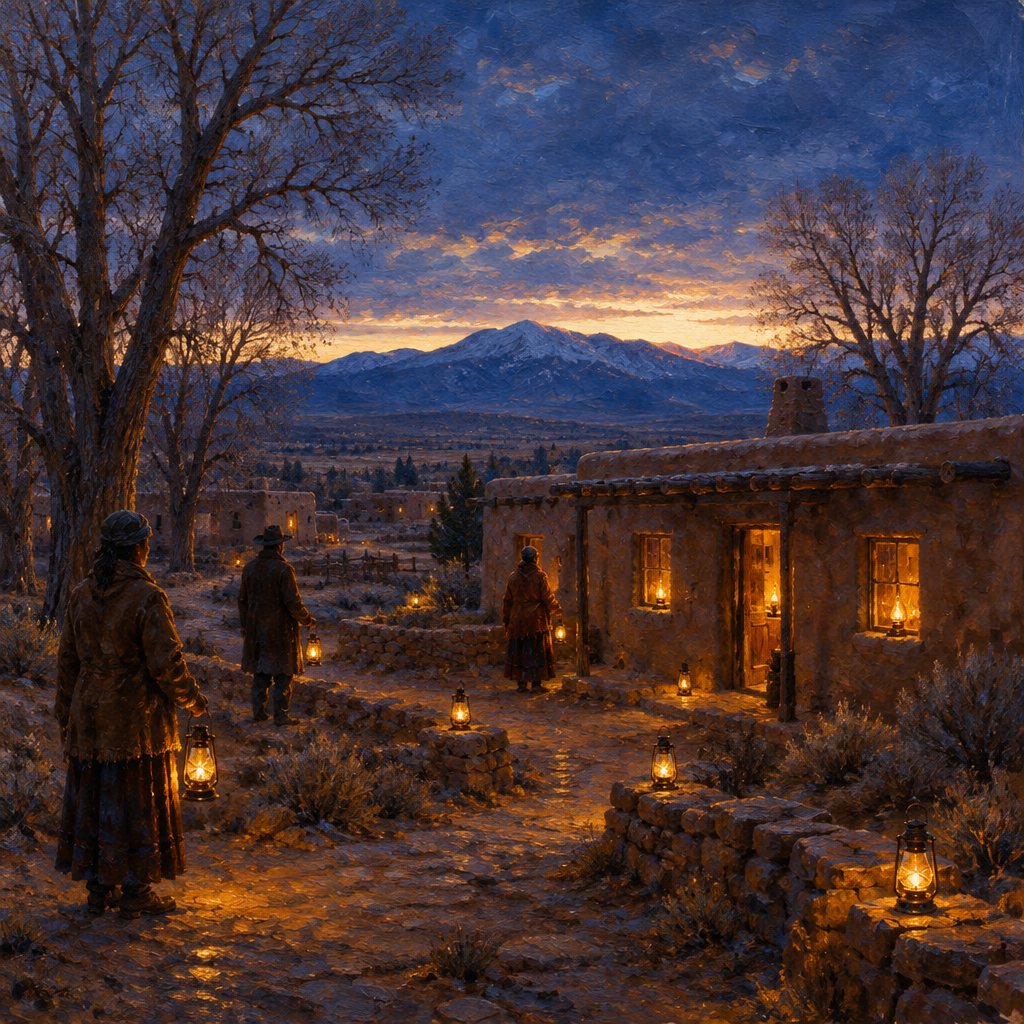
Oil in the Flask: A Village That Planned for the Dark
In Ojo Sarco, New Mexico, a village of about 300 people with no post office and a 40-minute round trip for groceries, a donated solar array and battery now keeps the community center's lights and its internet running even when the grid goes down. The center already carries a twice-monthly food bank, summer meals for children and a newly qualified state library, and the contractor installed the system at no cost after the town applied three years running. Three and a half years after a night that took seven members of one family, neighbors in Enoch, Utah are raising money for a healing garden with a bench for each of them, a space built deliberately for the long work of grieving with hope.
"We cannot control what happened, but we can choose how we respond to it. We can choose to heal and we can choose to come together as a community. So that's what we're doing."
— Cindy Baldwin, co-founder of Community Trauma Recovery, Enoch, Utah
Reflection
The Gospel for the Thirty-second Sunday in Ordinary Time is a story about a delay, and about what people did with the waiting. Ten young women bring lamps to meet a bridegroom who does not arrive on schedule. Five bring oil in flasks; five bring nothing but the flame already burning. When the cry finally comes at midnight, the difference between them is not sincerity or devotion. It is whether anyone had thought, in advance, about the long hours in between. Jesus does not praise the wise for predicting the hour. Nobody predicts the hour. He praises them for carrying something they could not improvise at the last minute. The first reading sets the same lesson in gentler language. Wisdom is resplendent and unfading, and she is found by those who seek her. She sits by the gate. She makes her rounds. Whoever watches for her at dawn will not be disappointed. That is not a promise that the watch is short. It is a promise that the watch is not wasted. Readiness, in these readings, looks less like anxiety and more like attentiveness: the patient, unglamorous habit of preparing for a need before the need announces itself. In Ojo Sarco, New Mexico, that habit has a very literal form. The village sits about 43 miles northeast of Santa Fe, unincorporated, with no political voice and a long memory of services leaving. Its community center occupies a building that began as a one-room schoolhouse and has since become the thing that fills the gaps: a food bank twice a month, summer meals for kids, safety classes, outings, and now the qualifications of a state library. When Paradise Power Company offered its annual donated solar array, the center applied and lost, and applied again, for three years. What arrived was a 7.5-kilowatt array with 10.6 kilowatt-hours of battery storage, installed at no cost. Carol Miller, who writes the grants and sits on the board, describes the effect in terms of a shoe-string budget finally getting some slack, and in terms of children who now come to library programs and are, as she puts it, solar oriented. When the power goes out, the internet does not. The lamp stays lit. There is a detail in that story worth holding onto. Daniel Weinman, whose father founded the company in 1972 when there was barely a solar industry to join, grew up in a house lit by kerosene lanterns until a solar system arrived and changed everything. The oil being passed along here is not metaphorical; it is a skill and a habit of mind handed from one generation to the next, and then handed outward to a village that had been waiting at the gate. The second reading turns to the other kind of waiting, the kind that has no remedy in hardware. Paul tells the Thessalonians not to grieve like people who have no hope, and then hands them words to console one another with. He does not tell them not to grieve. He tells them what shape their grief can take. Three and a half years after a January night that took a mother, a grandmother and five children from Enoch, Utah, a group of neighbors has formed a nonprofit and is raising money for a healing garden on land beside the cemetery. There will be a gazebo and a bench for each member of the family, and a sculpture by a local artist. Cindy Baldwin, who lived two doors down and shared a backyard fence with them, talks about the twirly slide her children still remember and about the strange, ordinary healing of becoming friends with the family who moved in afterward. Amy Nielson, a counselor in the town, describes mothers and fathers coming to ask whether they could ever become the kind of person who does such a thing, and asking for help making sure they never are. Both stories are about reserves built in advance. The wise women in the parable cannot lend their oil, and the point is not scarcity. It is that some things cannot be borrowed at the moment of crisis: the battery bank has to be installed before the storm, the garden has to be drawn and funded and planted before the anniversary, the habits of a community that shows up have to be practised while nothing is wrong. The psalm for this Sunday is one long thirst, sung in a dry and lifeless land, and it keeps returning to the night-watches. I will remember you upon my couch, and through the night-watches I will meditate on you. That is where the oil comes from. Not from foresight as a talent, but from keeping vigil as a practice, dawn after dawn, until the cry comes and the lamps are already trimmed. What both places have in common is that nobody there is waiting to be rescued by a dramatic gesture. A grant writer reapplies for the third time. A neighbor organizes a nonprofit and a cold plunge fundraiser. A contractor keeps donating an array a year because his father did. The kingdom in the parable arrives at midnight to find a few people awake with fuel in their hands, and the ordinary miracle is that this turns out to be enough.